

Intercropping, an agricultural practice that could help counterbalance the negative effects of agricultural specialisation by re-introducing crop diversity in fields, is currently facing strong resistance in Europe. Indeed, current European agricultural systems are locked in their current configuration due to their previous evolution path and strong interdependencies between actors. Many obstacles – called barriers – stand in the way of intercropping use in Europe.
During the first part of the IntercropVALUES project, the Sytra research team (Earth and Life Institute, UCLouvain) identified 189 barriers to intercropping, thanks to interactions with the leaders of the 13 Co-Innovation Case Studies (CICS) involved in the project. The same research team is now focusing on studying solutions to act on the identified barriers.

In view of the large number of barriers, the identification of solutions had to start first by finding, among the barriers, those with priority status according to field actors. Based on the results from four CICS, four groups of priority barriers were identified. These four groups include barriers related to:
- Standardization, selling & marketing: intercropping is lacking a proper market and demand from consumers, as well as proper marketing. In addition, downstream actors and consumers, especially in long value chains, impose quality standards that are difficult to reach with intercropping,
- Farming practices: crop management of intercropping, from sowing to harvest, poses numerous technical and organizational challenges for farmers.
- Post-harvest handling: intercropping poses numerous technical and organizational challenges regarding storage and sorting,
- Communication & involvement of actors: communication between actors of the value chain and involvement of a diversity of actors are too low to allow the development of intercropping.
Following the identification of priority groups of barriers, an online meeting with CICS leaders was organized. During this meeting, CICS leaders had the opportunity to discuss solutions they implemented in relation to the “standardization, selling & marketing” and the “farming practices” related barriers and to brainstorm about potential new solutions. The discussion was very rich, and the data collected during this meeting are currently undergoing analysis. A second online meeting is planned this month to brainstorm about solutions to act on the two remaining priority groups of barriers.
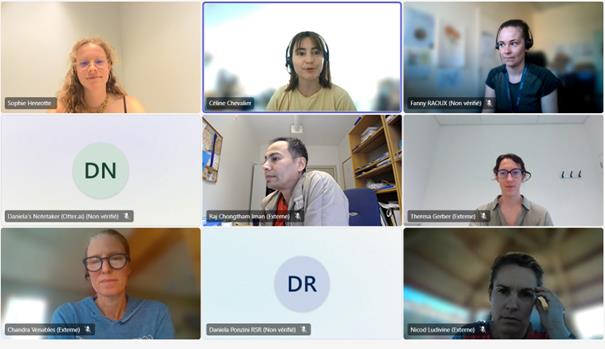
CICS leaders are attend an online meeting to discuss solutions in relation to different barriers.
This article was written by Céline Chevalier, from UCLouvain