
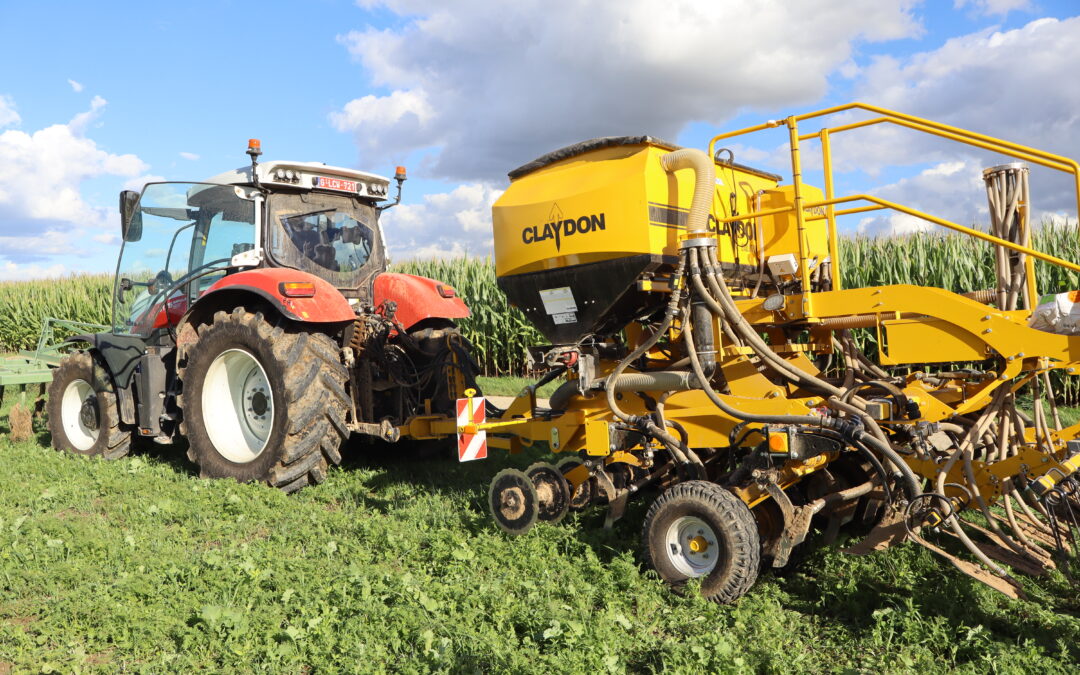
The adoption of species mixtures and intercropping systems is widely recognized as a promising pathway towards more resilient, productive and sustainable agricultural systems. However, one question is frequently raised by farmers and advisors alike: Do we have the right machinery to make these systems work in practice?
The newly published deliverable, D3.2 Practical guides and videos presenting innovative machineries designed or adapted by farmers related to sowing, mechanical weeding, harvesting, cleaning and sorting, and dissemination of operational solutions, provides inspiring answers to this challenge by documenting how farmers are developing practical machinery solutions to support species mixtures in real farming conditions.
From perceived barrier to innovation opportunity
Access to suitable agro-equipment is often considered a major obstacle to the adoption of species mixtures. Existing machinery may not always fit local farming conditions, and investing in new equipment can be expensive. Yet the findings of this study tell a different story.
Based on interviews with French farmers, the research reveals that machinery is rarely viewed as a reason to abandon species mixtures. Instead, farmers actively adapt, combine, modify and even build equipment to meet their specific agronomic needs. Through creativity, experimentation and collaboration, they transform existing machinery into solutions tailored to diversified cropping systems.
Practical examples from the field
The deliverable presents a range of innovative machinery solutions developed by farmers, with a strong focus on sowing operations, identified as the most critical stage for successfully establishing species mixtures.
Among the examples featured are:
- Fertiliser spreaders repurposed for sowing cover crop mixtures alongside main crops.
- Modified seed drills capable of sowing two species simultaneously at different depths.
- Combined machines designed to establish species mixtures in a single field pass.
- Farmer-built no-till drills specifically developed for multispecies cover crops.
- Flexible seed drilling systems designed to accommodate different species, sowing arrangements and management objectives.
These examples demonstrate the diversity of approaches farmers are adopting to improve efficiency while maintaining the agronomic benefits of species mixtures.
Understanding how farmers manage agro-equipment
The study also identifies three main agro-equipment management strategies used by farmers.
Some farmers focus on minimizing mechanization costs by repurposing existing equipment. Others adapt machinery to meet the specific biological requirements of different species. A third group builds their strategy around locally available resources, relying on contractors, cooperatives and service providers to access specialized equipment for sowing, harvesting and sorting.
The results highlight that there is no single pathway towards successful intercropping. Instead, farmers develop solutions that reflect their own resources, objectives and local conditions.
The co-evolution of machinery and species mixtures
One of the most important findings of the research is that machinery and species mixtures evolve together over time. As farmers gain experience with diversified cropping systems, they continuously refine both their agronomic practices and their equipment.
The study identifies three long-term design approaches:
- Frugal design, based on adapting existing equipment and limiting investments while testing new species mixtures.
- Standardized design, aimed at optimizing the large-scale production of diversified mixtures.
- Flexible design, where farmers gradually acquire and adapt machinery to maintain the ability to respond to changing conditions and opportunities.
These approaches illustrate the dynamic nature of innovation on farms and the crucial role of farmer expertise in driving sustainable agricultural transitions.
A resource for farmers, advisors and innovation actors
This deliverable is intended for a wide audience, including farmers, advisors, machinery cooperatives, service providers, researchers, agricultural engineers, equipment manufacturers and innovation support organizations interested in the development of species mixtures and intercropping systems.
By showcasing real-world examples and farmer-led innovations, the publication provides valuable inspiration for stakeholders seeking practical solutions to facilitate the adoption of more diversified and resilient cropping systems.
As IntercropVALUES continues to support knowledge exchange and co-innovation across Europe, these findings reinforce a key message: when farmers are empowered to adapt and innovate, agro-equipment becomes a catalyst for change rather than a constraint.
Read the full deliverable here