
CICS 05
Improving organic baking wheat through intercropping with pea: New product development, including technology and adjustments/redefining regulations
Topic
Milling and baking
Country
Germany
Responsible
UniKassel – Universität Kassel
Objectives
- Intercropping of wheat and pea to improve wheat baking quality
- Integration of ‘intercropped’ wheat into mills and bakeries
- Challenge current purity standards in terms of ‘foreign matter’
- Possible development of new protein products (through the inclusion of pea in baked goods)
Click here if you want to read the project flyer in German
What is the CICS about
Evaluation and integration of intercropped baking wheat and pea within short organic value chains in Germany. The CICS’ actors focused on the adaption and optimization of cultivation and processing methodologies, while aiming to redefine regulations where necessary to increase the uptake of wheat and pea intercrops, while exploring the development of new product lines/marketing avenues for intercropped products. The CICS’ actors included 9 organic farmers, five millers and 11 bakeries organized in short value chains across Germany. Intercropped baking wheat and pea were grown on-farm with both sole crops for comparison. After harvest the intercrops were either separated on-farm before being sent to the partner mill, or sent to the mill directly for separation and milling. The flour from the intercropped wheat was then sent to partner bakeries for inclusion in two baking campaigns, with each campaign running for a total of 8 weeks and included marketing material in order to educate consumers as to the benefits of intercrops and intercropped products.
Learnings
The adoption of baking wheat and pea intercrops for human consumption is challenging due to a number of bottlenecks found within the value chain. One of the biggest current issues is finding a suitable and profitable market for the legume (in our case pea). If such a market is not available, the intercropping with pea tends to be unattractive for farmers. In addition to this, if initial seed separation cannot take place on farm, millers lack the storage infrastructure to be able to store large quantities of pea for which they also have no market, unless there is a prior arrangement that the pea will be taken back by the farmers. This arrangement can be made if the farmer has another market avenue for the pea e.g. in the case of animal feed. However, this situation also makes it clear that grain sorting on farm either directly by the farmer, farmer cooperatives or mobile sorting units can reduce this infrastructural bottleneck at the mill.
During the project, the CICS worked together with bakers to find ways to integrate pea into baked products in order to find an alternative market for the intercropped pea. Bakers reported that the integration of up to 5% pea into baked goods is unproblematic and that no adjustments or changes to processing are needed to do so. Additionally higher percentages of pea could be integrated through the adoption of specific processing steps within the bakery, indicating the potential of forging new markets for pea. This result also confirms that pea residues (broken pea pieces) of up to 5% that remain in the wheat after grain separation are unproblematic for both the millers and bakers and as such negates the need for additional sorting steps, which would result in a higher price for intercropped products due to the additional sorting and cleaning steps.
Updates from
the CICS 05:
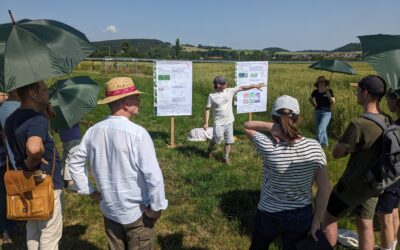
Bringing innovation to the grassroots: IntercropVALUES contributes to the Field Day at the University of Kassel in Germany
Around 200 participants gathered on 25 June 2026 at the Neu Eichenberg Teaching and Experimental Farm of the University of Kassel, Germany, for the event “Bringing innovation to the grassroots – Greater diversity, greater value”. The event brought together a diverse...
From barriers to identifying solutions: IntercropVALUES moves forward to promote intercropping
Intercropping, an agricultural practice that could help counterbalance the negative effects of agricultural specialisation by re-introducing crop diversity in fields, is currently facing strong resistance in Europe. Indeed, current European agricultural systems are...
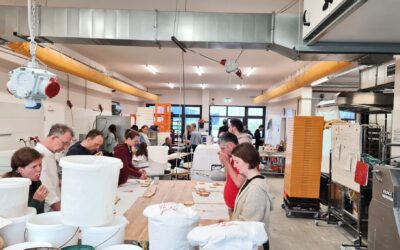
Intercropping wheat and pea for improved baking quality: more diversity from the field to the bread basket (Germany)
The main aim of the German CICS#5 (Co-innovation Case Study) is to tackle processing barriers and create solutions and knowledge on the cultivation, milling and baking of wheat grown as an intercrop with pea. The German CIC#5 is a partnership between the University of...

Intercropping wheat and pea for improved baking quality: more diversity from the field to the bread basket in Germany
The acceptance and adoption of sustainable arable farming strategies does not depend on agriculture alone. Agroecological innovations always affect the entire value chain, i.e. all processing stages, as well as consumers. Together with 25 actors including farmers,...

Stimulating the growth of the organic sector by developing intercropping practices
The 17th edition of the European Organic Congress, organized by IFOAM Organics Europe and Ecovalia, is currently taking place in Cordoba, Spain. On the picture above, Eduardo Cuoco (IFOAM Organics Europe) presents during the European Organic Congress 1st session on...

A summer to learn about intercropping
A summer to learn about intercropping Summer is starting and it is time to rest. The IntercropVALUES project started in November and the official kick-off took place at the end of that month, when all partners met in Montpellier to launch the activities and establish...
Check out the other 13 Co-innovation
Case Studies (CICS)
CICS 01 denmark
From Field to Flour: Wheat–Pea Intercropping Without Full Separation
CICS 02 sweden
LoBa – Local legumes, collaboration in
the entire value chain
CICS 03 uk
Or-Ganic / SCOCAN (SCottish Organic
CANola)
CICS 04 france
Supporting the integration of diverse intercropping systems into value chains in the South-West of France
CICS 05 germany
New product development including technology and adjustments/redefining regulations
CICS 06 greece
Intercropping for sustainable production of wheat and barley
CICS 07 reunion
New proven crop management strategies using service plants between the sugarcane rows
CICS 08 spain
Specific labelling to agri-food industry. Collective IPM actions and strategies
CICS 09 serbia
Creating prototype for local food value chain and operational solution for intercropping
CICS 10 france (west)
Local/regional values chains, up to national to bring out other groups in FNCUMA network
CICS 11 italy
Understanding and using the benefits of IC in complex farming systems and short value chains
CICS 12 mozambique
Promoting sustainable intercropping systems for agri-food value chain in Mozambique
CICS 13 switzerland
Enhancing food quality and developing value chains through organic wheat-faba bean intercropping
