
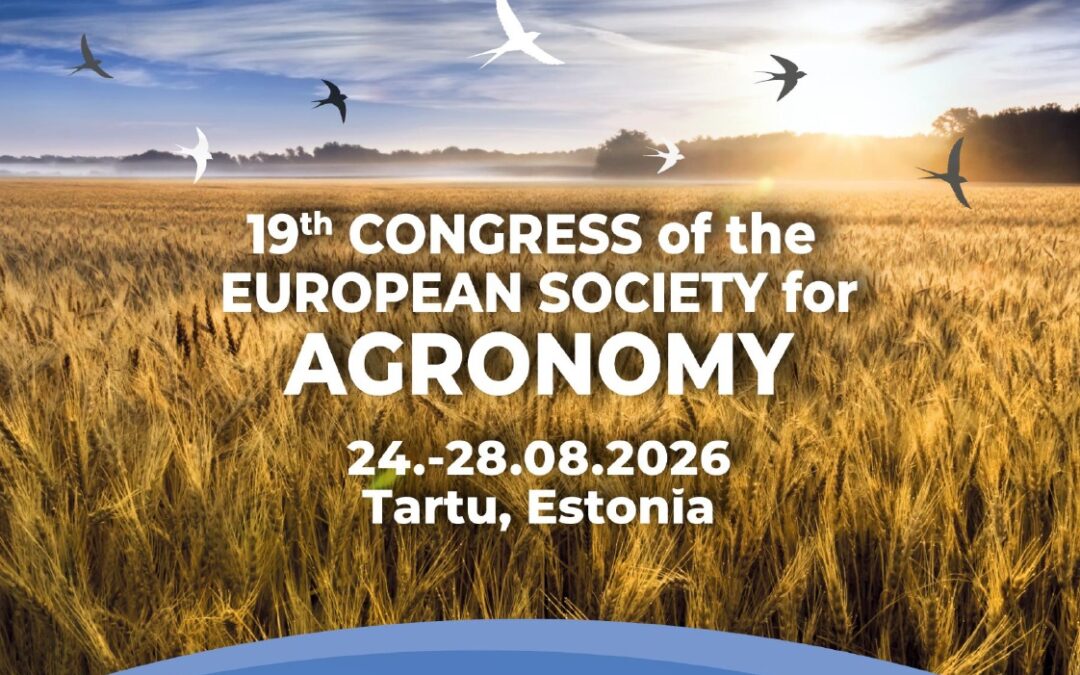
Tartu, Estonia – 28 August 2026 — The IntercropVALUES project was prominently represented at the European Society for Agronomy (ESA) 2026 Congress, held in Tartu, Estonia, from 24 to 28 August. The congress brought together researchers from across Europe and beyond to exchange the latest knowledge on sustainable crop production, agroecology, crop diversification and the future of European agriculture.
Eight IntercropVALUES representatives, Eric Justes, Kairsty Topp, Christine Watson, Catherine Bonazzi, Aliyeh Salehi, Sabine Seidel, Wopke van der Werf and Raj Chongtham, participated in the congress, bringing complementary perspectives on intercropping, from crop performance and environmental impacts to food quality, processing, consumer acceptance, plant health, weed management and cropping system sustainability.
Their contributions reflected the broad scope of IntercropVALUES, which goes beyond assessing intercrops solely in terms of agronomic performance. The project investigates how intercropping can contribute to ecosystem services, resource-use efficiency, food quality and viable agrifood value chains, while identifying the barriers and opportunities for wider adoption.
A keynote address on the future of intercropping in Europe
IntercropVALUES coordinator Eric Justes (CIRAD) played a prominent role at ESA2026 through his keynote presentation,“Intercropping, a Pillar of Agroecology in Action. How to Boost Its Adoption in European Agriculture?”
In his keynote, Justes presented intercropping as a practical and scientifically proven expression of agroecology, capable of addressing some of the most pressing challenges facing European agriculture, including climate change, biodiversity loss, dependence on external inputs and the need for more resilient farming systems.
Drawing on decades of research and experience from both the ReMIX and IntercropVALUES projects, he highlighted how species diversity can improve the efficiency with which crops use light, water and nutrients while enhancing resilience to environmental and economic risks. He also explained how interactions between crop species, including complementarity, cooperation and compensation effects, can contribute to higher productivity, improved resource-use efficiency and greater system stability.
A central message of the presentation was that the agronomic benefits of intercropping are now well documented, but adoption remains limited across Europe. To overcome this gap, Justes stressed the need to address barriers throughout the entire agrifood system, including harvesting, sorting, processing, marketing and policy support.
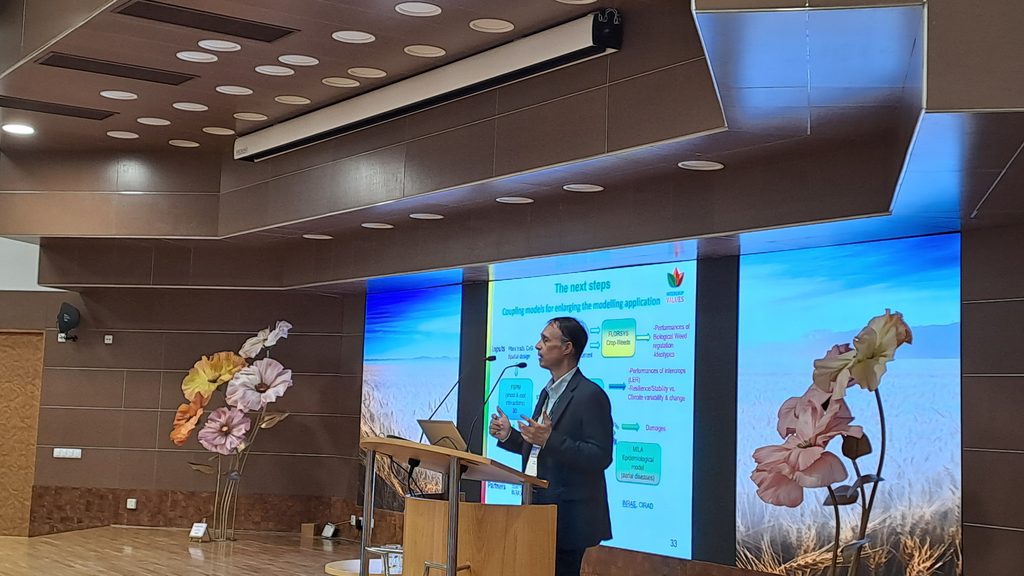
Eric Justes presents his keynote at the ESA 2026 Congress
From crop performance to environmental benefits
On 25 August, Kairsty Topp (SRUC) presented “The Impact of Cereal-Legume Intercropping on Yield and Nitrous Oxide Emissions.”
The presentation addressed two critical dimensions of intercrop performance: productivity and environmental sustainability. Drawing on results from field experiments conducted in Scotland, Sweden, Germany and Zimbabwe, the study explored the effects of cereal-legume mixtures on land-use efficiency and greenhouse gas emissions.
The findings showed that intercropping can reduce nitrous oxide emissions compared with sole crops while maintaining productive cropping systems. Such evidence contributes directly to IntercropVALUES’ objective of understanding how intercropping can support climate-smart and resource-efficient agriculture.
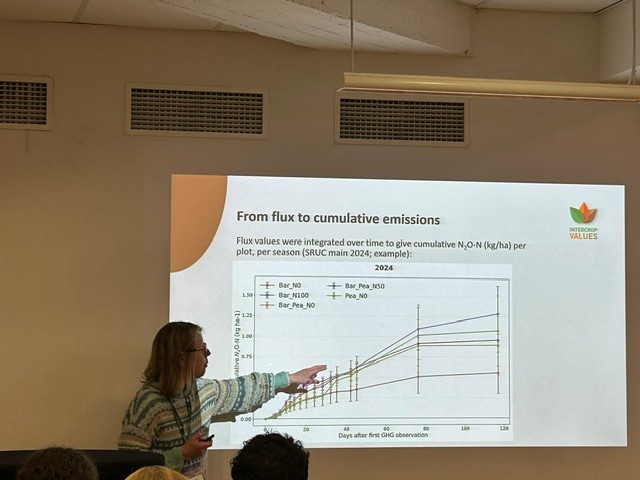
Kairsty Topp (SRUC) presents the result of her research at the 2026 ESA Congress.
Linking agronomy with food quality and consumer preferences
Also on 25 August, Catherine Bonazzi (INRAE) presented “Impact of Legume Content on Biscuit Processing and Consumer Preferences.”
Her contribution focused on a key question for the future of intercropping: what happens to intercrop products after they leave the farm?
Increasing the proportion of legumes in cereal-based mixtures influences grain characteristics and therefore affects food processing performance, product quality and consumer acceptance. Bonazzi’s presentation connected agricultural diversification directly with food innovation, demonstrating the importance of understanding the relationship between crop production, processing requirements and market opportunities.
This work aligns closely with IntercropVALUES research exploring the quality of grains harvested from cereal-legume intercrops and their potential use in innovative food products. Such studies are essential for developing value chains capable of supporting wider adoption of intercropping systems.
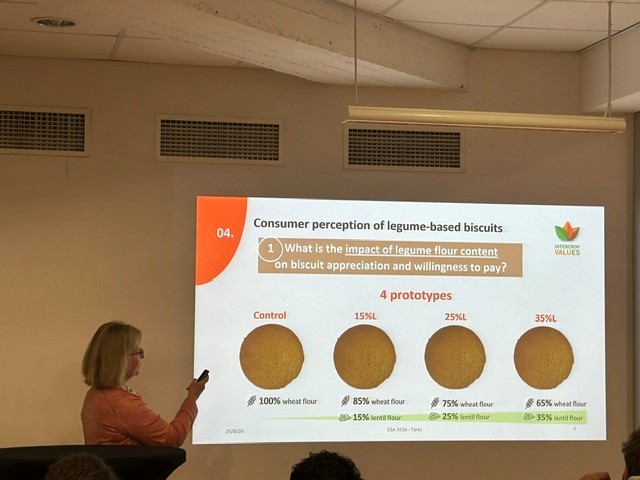
Catherine Bonazzi (INRAE), WP5 leader, presents the research she conducts in IntercropVALUES at the 2026 ESA Congress.
Valuing pulses beyond yield
Christine Watson (SRUC) contributed to the congress with her presentation*“The Price of Pulses: Going Beyond Yield in Valuing the Contribution of Pulses to People and Planet.”*
Her presentation highlighted the need to evaluate legumes and intercrops through a broader lens than yield alone. While agronomic performance remains important, pulses also provide nutritional, environmental and societal benefits that are often overlooked in conventional assessments.
Drawing on research from several European projects, including IntercropVALUES, Watson demonstrated the importance of considering multiple indicators when assessing legumes and intercrops, including their contributions to food security, environmental sustainability, biodiversity, human nutrition and farming-system resilience.
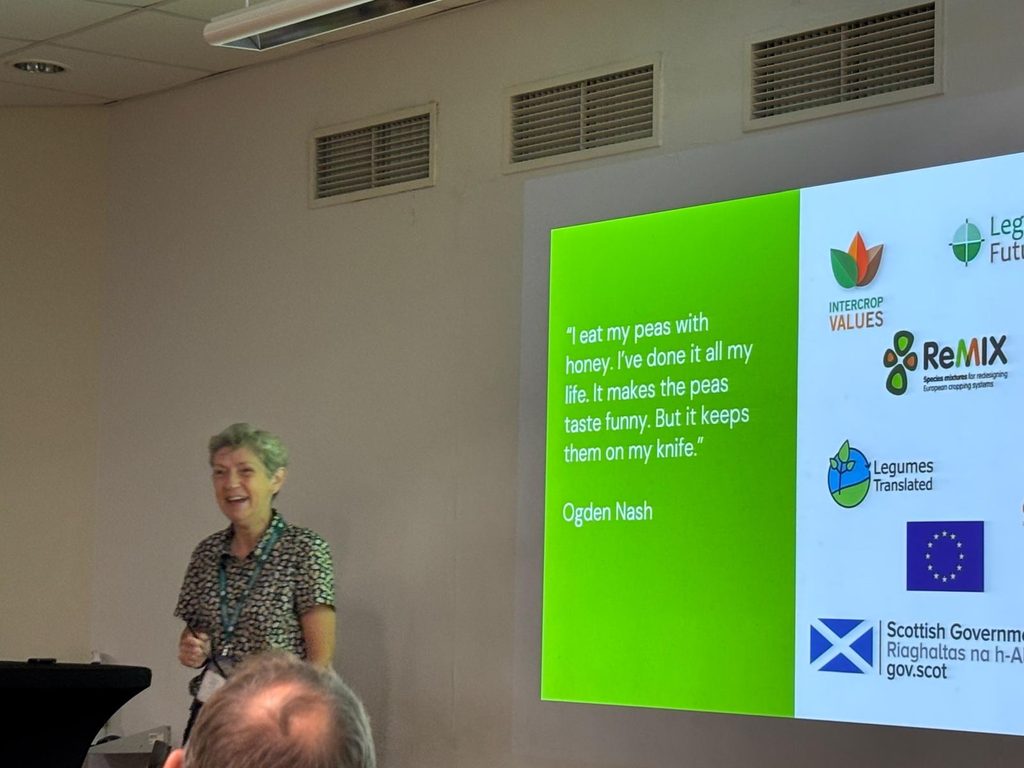
Christine Watson (SRUC), WP3 leader, also presented project results in her speech at the 2026 ESA congress.
Organic maize-soybean intercropping in practice
Another IntercropVALUES contribution came from Aliyeh Salehi (BOKU University, Austria), who presented “Performance of Organic Maize-Soybean Strip Intercropping in Austria.”
The research evaluated maize-soybean strip intercropping under organic management and different nitrogen fertilisation levels. Results showed that the system can improve land-use efficiency under certain conditions while maintaining grain quality and reducing dependence on external nitrogen inputs.
The study highlighted both the opportunities and management challenges associated with implementing intercrops in real farming systems. By examining factors affecting complementarity and competition between crops, the research contributes valuable insights into how intercropping can be optimised under practical farming conditions.
Intercropping for plant health and climate resilience
Another important contribution came from Wopke van der Werf (Wageningen University & Research), who presented “Intercropping Decreases Plant Disease Incidence: A Global Meta-analysis.”
Drawing on evidence from studies conducted worldwide, the presentation demonstrated how intercropping can significantly reduce plant disease incidence compared with monocultures. The findings highlighted the role of crop diversification as an effective agroecological strategy for improving crop health while reducing reliance on external inputs.
Sabine Seidel (BOKU University) also contributed to ESA2026 with her presentation*“Cross-site Comparison of Greenhouse Gas Responses of Temperate Cropping Systems to Weather Conditions and Management.”*
Her research examined how different management practices and climatic conditions influence greenhouse gas emissions across temperate cropping systems. The work contributes to a better understanding of the environmental performance of agricultural systems and provides valuable insights for the development of climate-smart farming strategies.
Intercropping as a tool for weed management
The project was also represented through the work of Raj Chongtham (Swedish University of Agricultural Sciences, SLU), who presented “Weed Suppression and Crop Performance in Winter Pea-based Intercropping Systems under Organic Management.”
The study explored the performance of winter pea intercrops under organic farming conditions, assessing their ability to suppress weeds while maintaining crop productivity. The results highlighted the potential of cereal-legume intercrops as an effective ecological weed-management strategy, supporting the development of low-input farming systems and contributing to the broader sustainability goals of European agriculture.
From field to food: building the evidence for transition
Taken together, the IntercropVALUES contributions at ESA2026 demonstrated how intercropping must be evaluated as part of an integrated agrifood system. The presentations covered topics ranging from crop productivity, greenhouse gas emissions and food quality to plant health, weed suppression, consumer acceptance and value-chain development, highlighting the multiple benefits of intercropping for a sustainable agricultural transition. They also highlighted the importance of addressing both biological interactions in the field and socio-technical barriers across the food system to enable wider adoption of intercropping across Europe.
As IntercropVALUES moves towards the final months of the project, participation in major scientific events such as ESA2026 provides an important opportunity to share results with the international scientific community and strengthen the partnerships needed to bring intercropping from experimental fields into practical farming and food value chains.
The project’s growing portfolio of scientific publications, practice abstracts and outreach materials continues to translate research findings into practical knowledge for farmers, advisors, processors, food companies, consumers and policymakers.
For more information about the project and its latest results, check our website!