
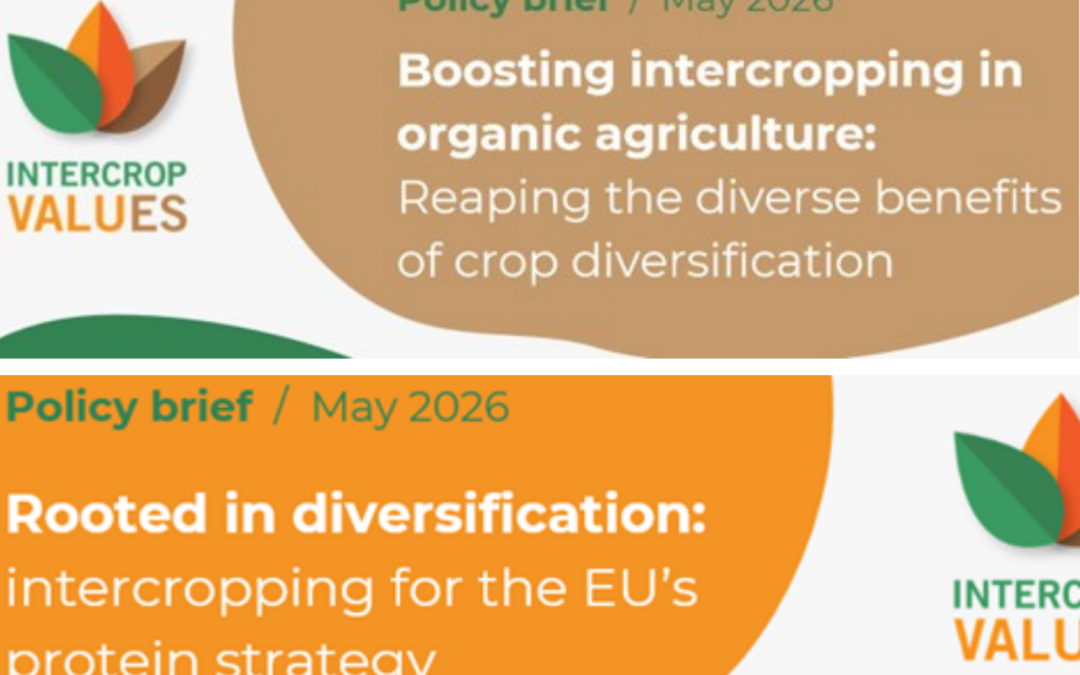
On the same day we reach the EU Parliament, two new briefs from our project come to the policy arena, reinforcing the case for intercropping as a cornerstone of Europe’s transition towards more resilient, sustainable and autonomous food systems. The publications address two critical and timely policy priorities: the EU protein strategy and the development of organic agriculture.
Together, the briefs provide concrete, evidence‑based recommendations for EU and national policymakers on how intercropping—also known as mixed cropping or species mixtures—can be better supported through upcoming reforms of agricultural, food and environmental policies.
The first brief, “Rooted in diversification: intercropping for the EU’s protein strategy,” responds to Europe’s continued dependence on imported plant proteins. At present, the EU imports around a quarter of the protein needed for livestock feed, leaving food systems exposed to geopolitical tensions, price volatility and high reliance on synthetic nitrogen fertilisers. IntercropVALUES highlights intercropping with legumes as a strategic solution to these challenges.
By combining cereals and legumes in the same field, intercropping enables biological nitrogen fixation, reduces the need for fossil fuel‑based fertilisers, and delivers more stable yields over time. The brief shows that cereal–legume intercropping can lower greenhouse gas emissions, improve soil health, enhance biodiversity and increase protein production efficiency. From a policy perspective, IntercropVALUES calls for intercropping to be explicitly recognised and rewarded under the post‑2027 Common Agricultural Policy (CAP), the revision of the Common Market Organisation, and the future EU protein diversification strategy.
The second publication, “Boosting intercropping in organic agriculture: reaping the diverse benefits of crop diversification,” focuses on the strong alignment between intercropping and organic farming principles. Intercropping relies on ecological interactions rather than synthetic inputs, making it particularly well suited to low‑input and organic systems. Organic farmers have long pioneered the practice, yet they continue to face economic, technical and market barriers to wider adoption.
This policy brief outlines how intercropping can support the EU Organic Action Plan, the next CAP, and Member States’ National Restoration Plans under the Nature Restoration Regulation. Key recommendations include targeted funding for advisory services and agricultural knowledge systems, investment in adapted machinery and processing infrastructure, adjustments to purity standards to enable mixed harvests, and the use of sustainable public procurement to create reliable markets for products from intercropping.
Across both briefs, IntercropVALUES emphasises a central message: agricultural policies should reward farming practices and systems that deliver public goods, rather than focusing narrowly on individual crops. Intercropping stands out as a knowledge‑intensive yet highly effective agroecological practice that enhances farm resilience, supports rural economies and contributes to the EU’s climate, biodiversity and food security objectives.
By turning scientific evidence into actionable policy guidance, these two policy briefs aim to support decision‑makers at a critical moment for European agriculture. IntercropVALUES calls for intercropping to move from the margins to the mainstream of EU food and farming policies—helping to build a more diversified, autonomous and sustainable future for Europe’s food systems.