
CICS 10
Local/regional values chains, up to national to bring out other groups in FNCUMA network
Topic
Shared equipment
Country
France
Responsible
FN CUMA
Objectives
CICS 10, part of the European IntercropVALUES project and located in the Angers region of France, initially aimed to develop a local supply chain for organic lentils intended for public catering services in the Angers area. The ambition was to address several barriers simultaneously:
- organic lentil production, by developing lentil-based intercrops and jointly establishing agronomic references with the farmers involved;
- post-harvest sorting, through a collective project to purchase an optical sorter via a Cuma (agricultural machinery cooperative);
- the development of collective market outlets for local public catering services.
By integrating agronomic, organisational, logistical and commercial aspects, the project helped improve understanding of the conditions required to develop a territorial food supply chain.
Click here if you want to read the project flyer in French
What is this CICS about
CICS 10 brings together around ten organic farmers from Maine-et-Loire and involves various stakeholders from the public catering and marketing sectors. It was coordinated by three partners: FNCuma and the Union des Cuma Pays de la Loire; GABB Anjou; and ENSFEA-INRAE UMR AGIR.
Activities were structured around three main areas:
-
The design and assessment of intercrops, mainly lentil-based combinations (lentil–camelina, lentil–barley and lentil–flax), as well as other cereal–legume mixtures, coordinated by ENSFEA-INRAE UMR AGIR.
-
Exploring post-harvest sorting solutions through a collective project to purchase an optical sorter via a Cuma, led by FNCuma and the Union des Cuma Pays de la Loire.
-
Exploring market opportunities for the legumes produced, particularly in local public catering, led by GABB Anjou.
Over four growing seasons (2023–2026), participating farmers tested different intercropping combinations. They received scientific support in designing the mixtures, including species selection and sowing rates, as well as agronomic monitoring to assess crop density, biomass, weed pressure, lodging, yield and harvest quality. In parallel, several actions were carried out to identify the needs of public catering stakeholders, test the use of locally grown lentils in catering services and explore different forms of collective organisation.
Learnings
One of the main lessons from CICS 10 is that barriers to intercropping adoption go beyond agronomic challenges.
Technically, farmers gradually adapted their practices, particularly in bruchid management, harvesting and companion species selection, with support from field visits, group discussions and individual guidance.
Logistically, the planned collective purchase of an optical sorter did not materialise due to organisational, workload and financial challenges. Existing sorting services already available to farmers also reduced the need for shared investment.
Commercially, actual sales of local organic lentils to public catering services fell short of the potential identified. Public procurement procedures and established suppliers made it difficult to promote local production.
Results
CICS 10 showed that developing a local supply chain for intercropped legumes depends on organisational, logistical and commercial factors as well as agronomic performance. Differences between farmers, particularly in their marketing approaches, made it difficult to establish a common strategy.
The project highlighted the importance of addressing farmers’ individual needs through tailored support, while also creating opportunities for collective exchange to encourage experimentation, collaboration and knowledge sharing.
Available resources
Contact
Updates from
the CICS 10:

Intercropping with Lentils and Peas in Organic Farming: Lessons from Two Student Internships in France
Within the IntercropVALUES project, two consecutive internships were conducted in 2024 and 2025 with organic farmers in the Maine-et-Loire region (France). Both internships were carried out under the CICS #10, coordinated by the Union of Cuma of Pays de la Loire and...
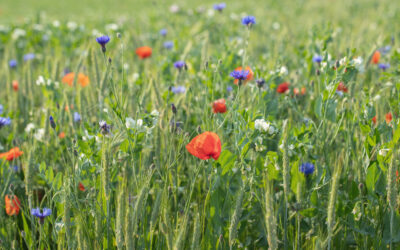
From barriers to identifying solutions: IntercropVALUES moves forward to promote intercropping
Intercropping, an agricultural practice that could help counterbalance the negative effects of agricultural specialisation by re-introducing crop diversity in fields, is currently facing strong resistance in Europe. Indeed, current European agricultural systems are...
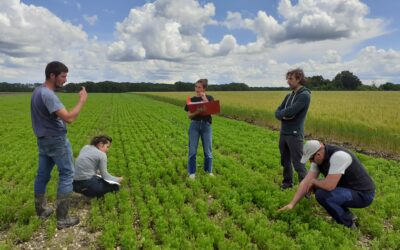
Two Years of Lentil Trials: Progress, Challenges, and Future Plans in CICS #10
Two years of agronomic trials: where does CICS 10 stand? In 2023, a group of farmers in the Anjou region began a series of full-scale experiments on lentil-based associated crops, with the aim of marketing these lentils to local caterers. A year later, the group's...

First trials of lentil-based mixtures in Case Study # 10 (Anjou region, France)
Co-Innovation Case Study (CICS) #10 is composed of a group of 15 farmers in the Anjou region: all of them are in organic farming and some are members of a CUMA (Cooperative for the Use of Agricultural Equipment). Their shared long-term objective is to integrate...

Stimulating the growth of the organic sector by developing intercropping practices
The 17th edition of the European Organic Congress, organized by IFOAM Organics Europe and Ecovalia, is currently taking place in Cordoba, Spain. On the picture above, Eduardo Cuoco (IFOAM Organics Europe) presents during the European Organic Congress 1st session on...

A summer to learn about intercropping
A summer to learn about intercropping Summer is starting and it is time to rest. The IntercropVALUES project started in November and the official kick-off took place at the end of that month, when all partners met in Montpellier to launch the activities and establish...
Check out the other 13 Co-innovation
Case Studies (CICS)
CICS 01 denmark
From Field to Flour: Wheat–Pea Intercropping Without Full Separation
CICS 02 sweden
LoBa – Local legumes, collaboration in
the entire value chain
CICS 03 uk
Or-Ganic / SCOCAN (SCottish Organic
CANola)
CICS 04 france
Supporting the integration of diverse intercropping systems into value chains in the South-West of France
CICS 05 germany
New product development including technology and adjustments/redefining regulations
CICS 06 greece
Intercropping for sustainable production of wheat and barley
CICS 07 reunion
New proven crop management strategies using service plants between the sugarcane rows
CICS 08 spain
Specific labelling to agri-food industry. Collective IPM actions and strategies
CICS 09 serbia
Creating prototype for local food value chain and operational solution for intercropping
CICS 10 france (west)
Local/regional values chains, up to national to bring out other groups in FNCUMA network
CICS 11 italy
Understanding and using the benefits of IC in complex farming systems and short value chains
CICS 12 mozambique
Promoting sustainable intercropping systems for agri-food value chain in Mozambique
CICS 13 switzerland
Enhancing food quality and developing value chains through organic wheat-faba bean intercropping
