
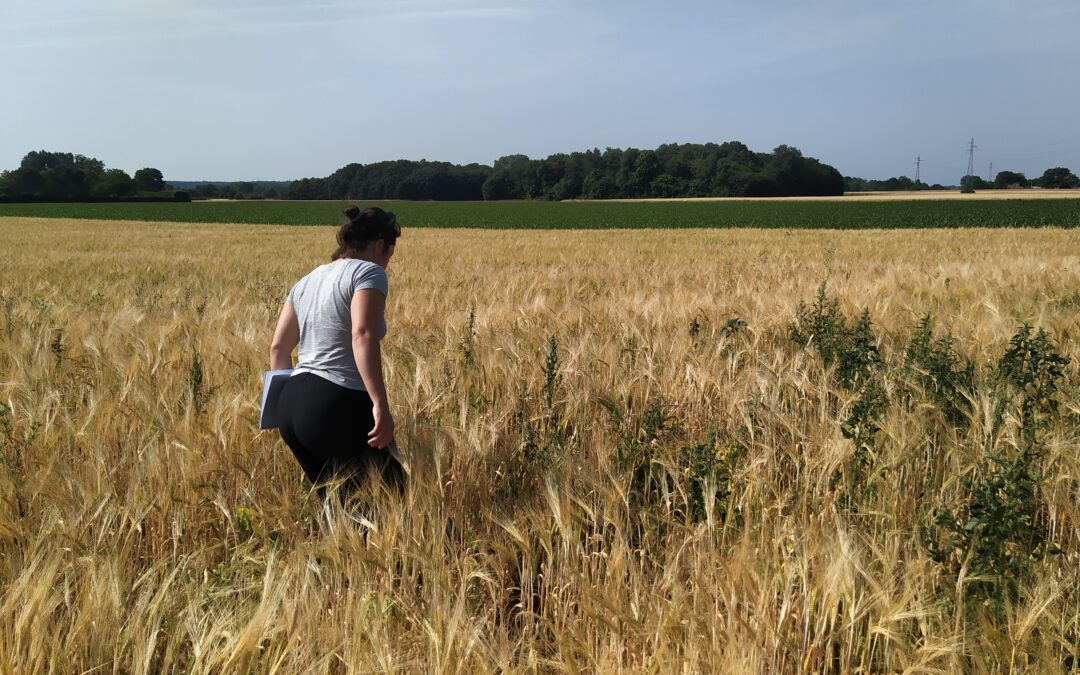
Within the IntercropVALUES project, two consecutive internships were conducted in 2024 and 2025 with organic farmers in the Maine-et-Loire region (France). Both internships were carried out under the CICS #10, coordinated by the Union of Cuma of Pays de la Loire and the GABB Anjou, with the support of INRAE. Their shared aim was to assess how intercropping could secure lentil and pea production in organic systems and improve local value chains, especially for supplying collective catering.
Margot Petit (2024): Testing Intercrops Against Lodging and Weeds
Margot Petit monitored nine plots across five farms, where lentils were grown in association with camelina, spring barley, or linseed. Each trial included a sole-crop lentil as a control. Her monitoring focused on crop establishment, canopy cover, biomass, yields, lodging, weed pressure, and bruchid damage.
Her results showed clear agronomic benefits of intercropping. Mixed crops frequently reduced lodging of lentils and improved competition against weeds. For instance, lentil/camelina mixtures had significantly less lodging than pure lentils, and lentil/barley mixtures showed lower weed biomass. While lentil yields remained variable, the total yield (lentil + companion crop) was more stable than lentil alone. However, intercropping did not reduce but did not increase bruchid damage, which remained a major issue, with infestation rates above 20% in several plots. Another critical finding was the economic bottleneck at the post-harvest stage: without appropriate sorting and cleaning, commercial yields were often downgraded and sometimes halved.

Above: intercropping of wheat and faba bean.
Léane Lorion (2025): Broader Intercrops and Post-Harvest Strategies
One year later, Léane Lorion expanded the trial to twelve plots on five farms, including mixtures of lentil/camelina, lentil/barley, pea/barley, and pea/spelt. The year was marked by early heat and drought, strongly reducing yields. Three lentil/camelina plots could not even be harvested due to poor establishment and low crop height but a similar result would have been obtained with pure lentils.
Léane’s analysis revealed highly heterogeneous results. Some mixtures succeeded in limiting lodging and weed pressure, while others failed (no effect). Importantly, no significant correlation was found between biomass of the component species of the mixture, nor between biomass of the whole mixture and weed suppression. Similarly, the expected “tutor effect” of cereals on lodging lentils was not consistently observed.
She also investigated post-harvest strategies against bruchids, comparing freezing and asphyxiation with untreated batches showing infestation levels between 10 and 30% of grains depending on the batch. Surprisingly, neither method showed a significant reduction in bruchid rates compared with untreated samples, probably due to the very advanced larval development of the bruchid in conjunction with the particularly hot weather conditions at the end of the cycle. However, this result should not call into question the need to freeze or asphyxiate batches to guarantee the quality of cereals in organic systems.
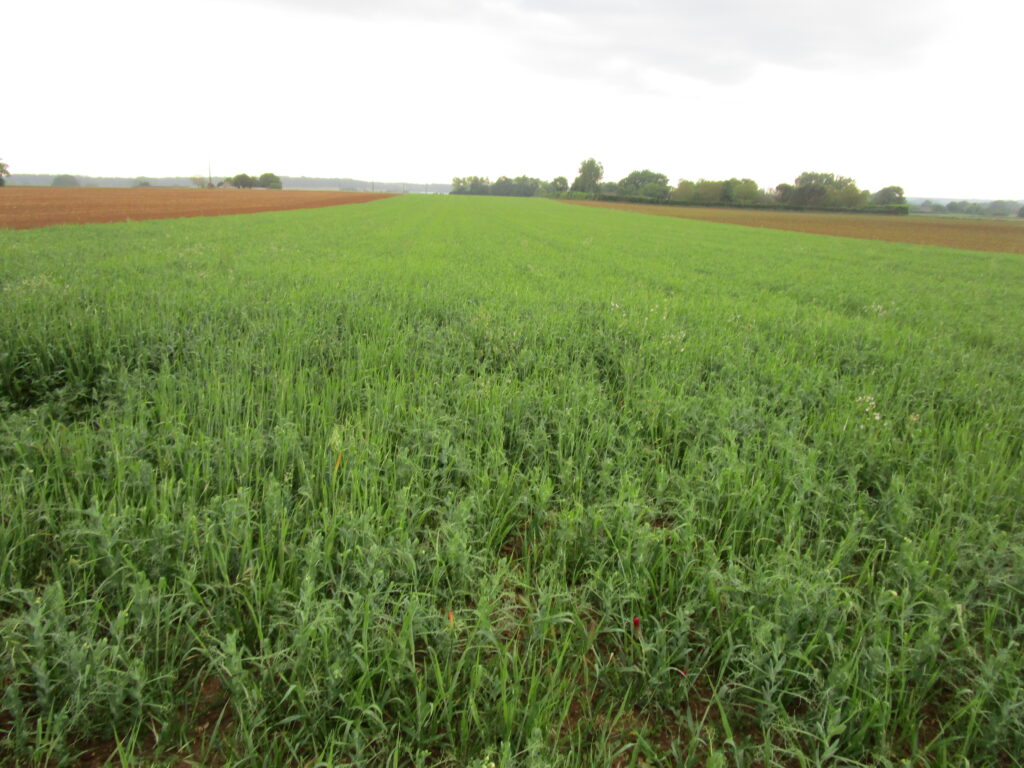
Above: intercropping of pea and barley
Complementary Insights
Together, these two works provide complementary lessons:
- Margot’s work (2024) demonstrated that intercropping can secure lentil production by reducing lodging and weed pressure, and by stabilising yields when considering both crops.
- Léane’s work (2025) highlighted the variability of outcomes depending on climate, species, and densities, while stressing the importance of the post-harvest stage and the need for reliable collective equipment for cleaning and storage.
Both studies converge on a crucial point: intercropping alone is not enough to secure a profitable lentil or pea value chain in organic farming. Technical solutions (choice of species, sowing densities, harvest management) must be combined with collective investments in sorting and processing equipment to ensure commercial viability.
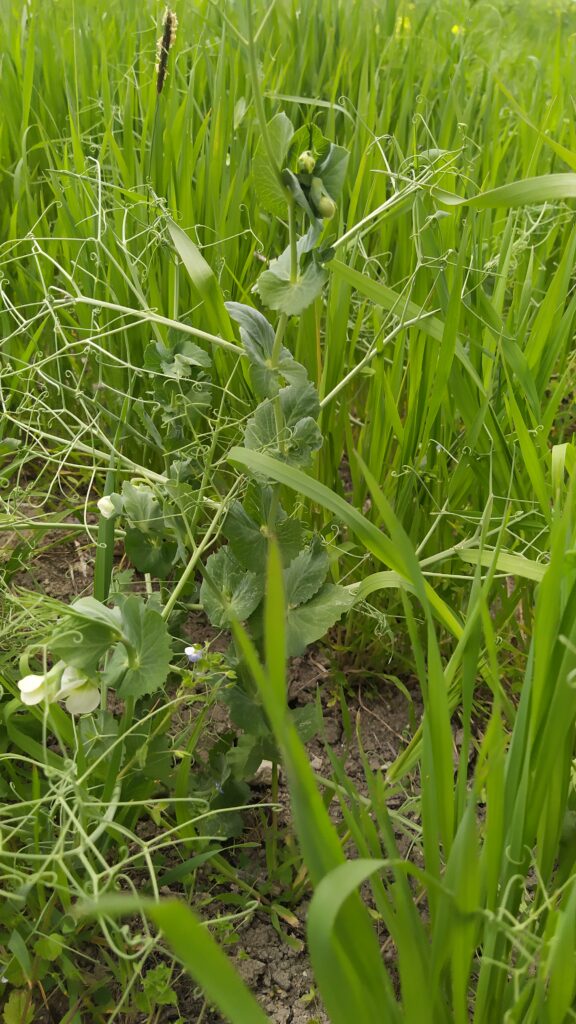
Above: intercropping of pea and einkorn wheat
Perspectives for Intercropvalues and Farmer Cooperatives
For the Cuma network, these findings underline the importance of collective organisation. Pooling investments in optical sorters, storage facilities, and processing chains appears essential to unlock the economic value of intercropped legumes. The studies also confirm that co-design with farmers is necessary since objectives differ between farms (lentil as main crop vs. cereal as cash crop), and success depends on local pedo-climatic conditions.
At the European scale, the French case study contributes evidence that intercropping with legumes can work in organic systems, but success is context-dependent and requires systemic solutions, from field design to value-chain organisation. Continuing experimentation and knowledge sharing within Intercropvalues will be key to building robust technical and economic references for farmers across Europe.
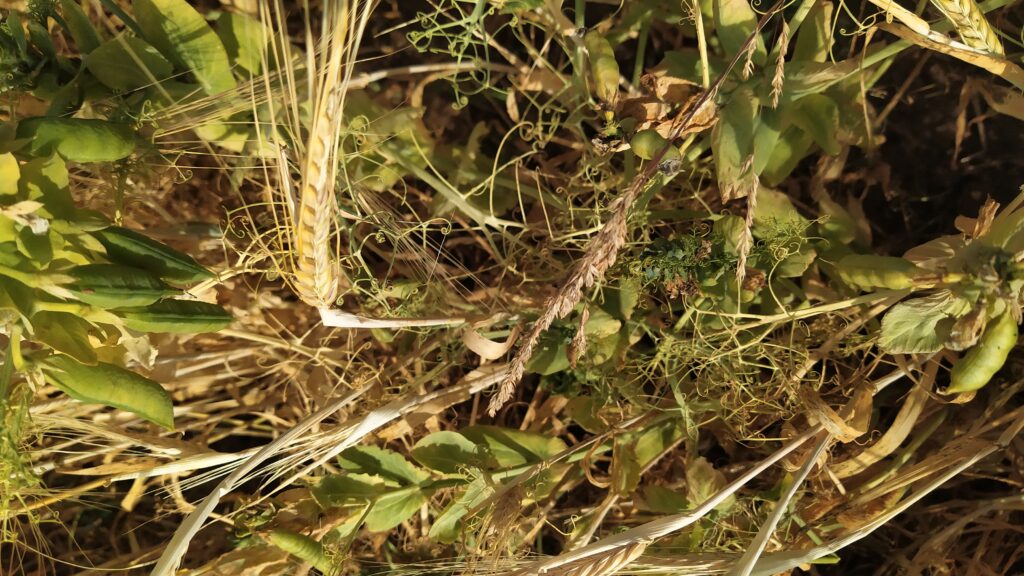
Above: close-up photo of wheat and pea intercropped.
For French speakers, Margot and Léane’s complete studies are available here:
This article was written by Annabelle Revel (FNCUMA)