

News
In this section you can find out first-hand about the latest news
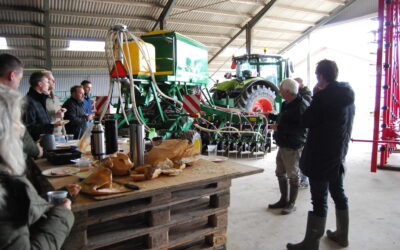
Lock-ins in Denmark are a barrier to intercropping practices and food system innovation
By Emilie Hansted Berning, Pernille Aavild Juhl, Ane Kirstine Aare and Henrik Hauggaard-Nielsen, Department of People and Technology, Roskilde University (RUC). Denmark’s export-oriented agricultural sector, driven by strategies to maximize production per input unit...
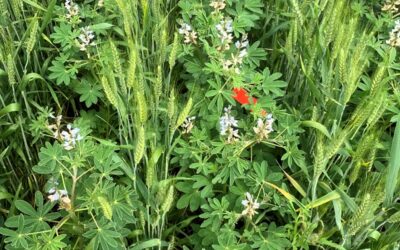
Does white lupin like the belowground company of wheat?
In a previous project’s news (November 2023) we emphasized that a great deal of plant-plant interactions in intercropping take place in the hidden root zone, and presented a rather simple phenotyping pipeline to measure root traits based on rhizoboxes. These boxes...

Fostering Collaboration and Innovation in Switzerland in Culinary Practices
Over the past few months, the IntercropVALUES team at FiBL has been focused on strengthening connections within the value chain and identifying barriers related to intercropping wheat and faba bean for food production. In May, the team organised a multi-stakeholder...
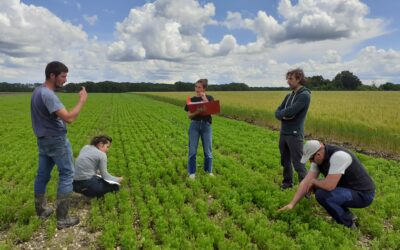
Two Years of Lentil Trials: Progress, Challenges, and Future Plans in CICS #10
Two years of agronomic trials: where does CICS 10 stand? In 2023, a group of farmers in the Anjou region began a series of full-scale experiments on lentil-based associated crops, with the aim of marketing these lentils to local caterers. A year later, the group's...
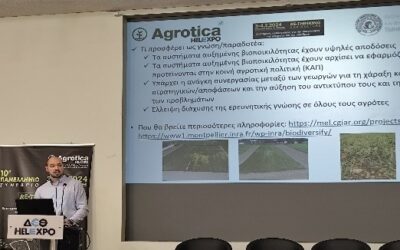
Faculty of Agriculture at Aristotle University of Thessaloniki: A look back at 2024
The Faculty of Agriculture at Aristotle University of Thessaloniki (AUTH), a key partner in the IntercropVALUES project, has been actively advancing intercropping practices through innovative research, stakeholder engagement, and field experiments. Over the past year,...

Identifiying lock-ins and barriers to intercropping through the value chain
In the context of the current agricultural specialisation in Europe, intercropping, an agroecological practice corresponding to mixtures of arable crops in the same field, is particularly relevant. By reintroducing diversity in arable lands, it could help...

Is Intercropping Feasible in Real-World Situations? Questions from Curios Swedish Food System Stakeholders
Drone view of the intercropping of wheat and pea experiment in Lönnstorp (pic: Ryan D) Cropping systems in Southern Sweden are highly specialized; focused on producing arable cash crops with a high dependence on external inputs such as fertilizers, weed control...

Learning about intercropping as a means to sustainable agriculture at Wageningen University
The project IntercropVALUES aims to exploit the benefits of intercropping to design and manage productive, diversified, resilient, profitable, and environmentally friendly cropping systems that are acceptable to farmers and actors across the agri-food chain. To...

Press Release #3: IntercropVALUES partners met in Louvain-La-Neuve for annual meeting
Last week, members of the 25 entities involved in the project IntercropVALUES met in Louvain-La-Neuve (Belgium) for their second annual consortium meeting. Their goal was, on the one hand, to discuss all the work done since the project started, two years ago. In...

University of Bonn: Pioneering the Future intercropping in the IntercropVALUES Project
As global challenges like climate change and food security intensify, the need for innovative, resilient, and sustainable farming methods has never been more critical. The University of Bonn plays a pivotal role in achieving the objectives of the IntercropVALUES...

Two new PhD theses on intercropping
Zishen Wang and Bei Dong earned their PhD from Wageningen University in May 2024, under the supervision of Dr. Wopke van der Werf, Dr. Tjeerd Jan Stomph, and Prof. Dr. Jochem Evers. Both theses were part of ReMIX project, the predecessor of IntercropVALUES. The...

Advances in a maize/soybean intercropping experiment conducted by the China Agricultural University
During June and July 2024, Professor Long Li and Dr. Rui-Peng Yu organized two field trips to visit the maize/soybean intercropping experiment in Zhangye, Gansu Province, PR China, which is included as one of the meta-experiments in WP 2 in IntercropVALUES Project. In...

POLICY BRIEF RELEASE. Desiging “intercrops friendly” policies: lessons from the analysis of barriers in Europe
Growing multiple crops simultaneously on the same field, the so-called “intercropping” practice has almost disappeared from our European agricultural landscapes, despite its numerous environmental, economic, and nutritional benefits. The IntercropVALUES project, which...

Learning from the experience of seven organic farms practicing intercropping in Italy
Intercropping can offer many potential advantages over single stand cropping systems when applied in organic farming: it optimizes the management of resources, increases agricultural biodiversity, allows better weed control, preserves the fertility of the soil and...

“It´s in the soil”: IntercropVALUES tells its own “soil story” in the French digital magazine from the Eïwa cooperatives
Lionel Alletto, researcher at INRAE and leader of IntercorpVALUES Co-Innovation Case Study 4, has recently participated in a local tv/online emission called (in French) C dans l’ sol (“It’s in the soil”). Yves Ferrier, from the Chamber of Agriculture and co-leader of...